
When you're setting up a website or growing an existing one, one of the first — and most important — decisions you'll make is choosing the right type of hosting. For most Indian businesses, the debate comes down to two options: shared hosting or a VPS (Virtual Private Server). Both have their place, but picking the wrong one can cost you in performance, security, and ultimately, revenue.
This guide breaks down the real differences, with no jargon, so you can make the right call for where your business is today — and where it's headed.
What Is Shared Hosting?
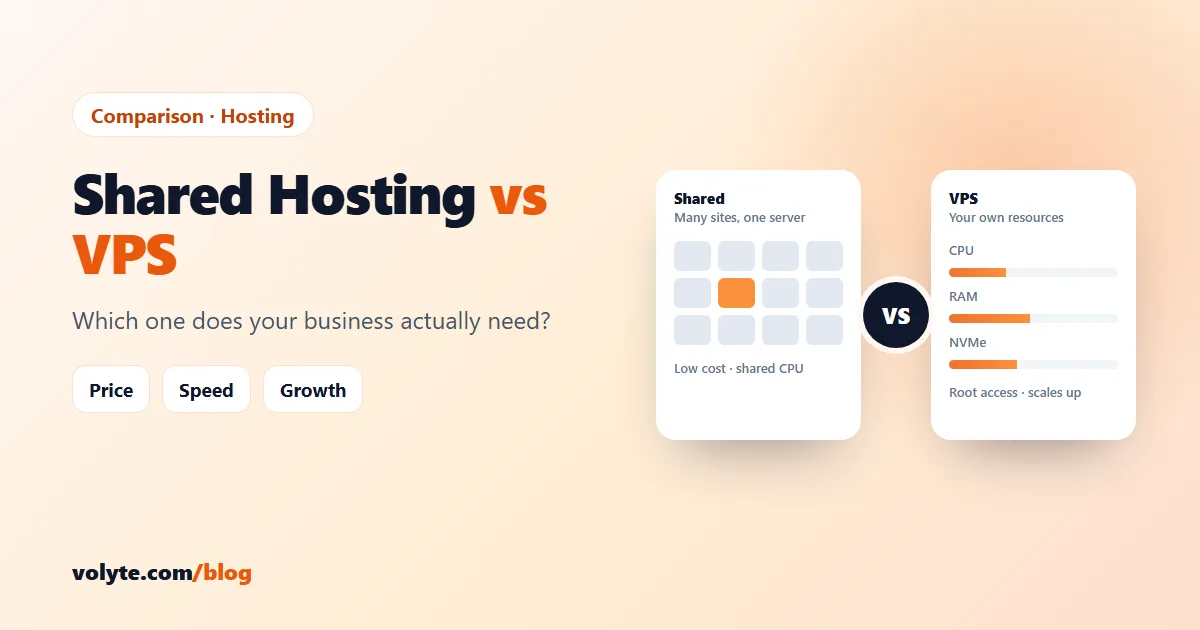
Shared hosting is exactly what it sounds like — your website shares a physical server with dozens (sometimes hundreds) of other websites. The hosting provider manages the server, and all tenants split the available CPU, RAM, and bandwidth.
It's the most affordable option and works well for websites with low to moderate traffic. Think of it like living in a shared apartment: affordable, convenient, but you don't control the noise from other tenants.
- Starting price: As low as ₹99/month with Volyte
- Best for: Blogs, portfolios, small business brochure sites
- Management: Fully managed — no server knowledge required
What Is VPS Hosting?
A VPS is a virtualized server that gives you a dedicated slice of a physical machine. Unlike shared hosting, your CPU, RAM, and storage are reserved exclusively for you. Other users on the same physical hardware cannot consume your resources.
Think of a VPS like owning a flat in a building — same building, but your space is entirely yours. You have root access, full control over your environment, and the ability to install any software you need.
- Starting price: From ₹999/month with Volyte
- Best for: E-commerce stores, SaaS apps, high-traffic websites, developers
- Management: Fully managed by our team — with full root access if you want it
Shared Hosting vs VPS: A Head-to-Head Comparison
Here's how the two stack up across the factors that matter most for Indian businesses:
| Feature | Shared Hosting | VPS Hosting |
|---|---|---|
| Price | From ₹99/mo | From ₹999/mo |
| Performance | Shared — affected by neighbours | Dedicated — consistent speed |
| Security | Basic — shared environment | Isolated — much stronger |
| Scalability | Very limited | Easily upgradeable |
| Root access | No | Yes (full control) |
| Traffic handling | Low to moderate | High — handles traffic spikes |
| Dedicated IP | No (shared) | Yes, included |
| Technical skill needed | None | None — fully managed with Volyte |
The "Noisy Neighbour" Problem with Shared Hosting
One of the most overlooked risks of shared hosting is what the industry calls the "noisy neighbour" effect. If another website on your server experiences a traffic surge — during a Diwali sale, for example — it eats into the shared resources, and your site slows down as a result.
You have zero control over this. For a business that depends on its website for leads, bookings, or direct sales, this unpredictability is a serious risk. With a VPS, your resources are yours alone — no other tenant can touch them.
When Shared Hosting Is the Right Choice
Shared hosting isn't bad — it's just designed for a specific stage. It makes perfect sense if:
- You're launching a new blog, portfolio, or informational website
- You expect fewer than 10,000 monthly visitors initially
- You have no technical background and want the simplest, lowest-cost setup
- You're testing a business idea and want to keep upfront costs minimal
Volyte's shared hosting plans start at just ₹99/month and include NVMe storage, unlimited email accounts, and a free SSL certificate — more than enough to launch and validate your idea.
When You Should Upgrade to VPS
There are clear signals that your business has outgrown shared hosting. Consider switching to a VPS if:
- Your website is regularly slow or times out during peak hours
- You're running an e-commerce store and can't afford downtime
- You're a developer who needs to install custom software or configure the server environment
- You're handling customer data or payments and need better security isolation
- You're running a SaaS product, game server, or API backend
- Your monthly traffic has crossed 25,000–50,000 visits
"We were on shared hosting for two years. The moment we launched a paid marketing campaign, our site went down. We lost ₹40,000 in ad spend with nothing to show for it. Moving to Volyte VPS was a no-brainer after that."
— Founder, D2C fashion brand, Jaipur
What About the Cost Difference?
The jump from ₹99/month to ₹999/month can feel steep, but it's worth putting into context. If your website generates even a handful of orders per day, the cost of one hour of downtime far exceeds the difference in monthly hosting fees. VPS hosting is not an expense — it's an investment in uptime, speed, and customer trust.
Volyte's VPS plans start at ₹999/month and include 4 vCPU cores, 8 GB RAM, 100 GB NVMe storage, a dedicated IP, and full root access. For growing businesses, that's exceptional value.
Can You Move from Shared Hosting to VPS Easily?
Yes — and with Volyte, migration is free on all plans and handled for you. Our team moves your website, databases, and email configurations with minimal downtime, so your visitors barely notice the transition.
Our Recommendation
If you're just starting out, shared hosting is a smart and affordable way to get online. But if your website is your primary business channel — or it's growing into one — a VPS is the upgrade you'll be glad you made sooner rather than later.
Not sure which plan fits your stage? Explore Volyte VPS plans or start with shared hosting — our team is available 24/7 to help you decide.
Frequently Asked Questions (FAQ)
1. Is shared hosting good enough for a small business website in India?
Yes, for most small business websites with moderate traffic — such as a local service provider, restaurant, or informational site — shared hosting is perfectly adequate. Volyte's shared hosting plans include NVMe storage and free SSL, making them a solid starting point. Once your traffic grows consistently, upgrading to VPS becomes the natural next step.
2. How much traffic can shared hosting handle before it starts struggling?
This varies by provider and plan, but as a general rule, shared hosting starts showing performance issues when you consistently exceed 10,000–20,000 monthly visits or run resource-heavy applications like WooCommerce with a large product catalogue. Sudden traffic spikes from campaigns or seasonal sales can push this limit even earlier.
3. Do I need technical knowledge to manage a VPS?
No. Every Volyte VPS is fully managed — our team handles server setup, security patches, and monitoring on your behalf. You get all the performance benefits of a VPS without needing to be a sysadmin, and you still have full root access if you want it.
4. Will my SEO rankings improve if I switch from shared to VPS hosting?
Indirectly, yes. Google uses page speed and Core Web Vitals as ranking factors. A VPS delivers faster load times and more consistent uptime, both of which contribute positively to your SEO performance over time — especially for competitive keywords in the Indian market.
5. Can I upgrade from shared hosting to VPS later without losing my data?
Absolutely. Volyte's migration team handles the full transition from shared hosting to VPS — including all your website files, databases, and email accounts — free of charge, with zero data loss and minimal downtime. You can start on shared hosting today and upgrade whenever your business is ready.