
If your website has started slowing down at the worst possible moments — right when traffic picks up, right after a marketing push, right when a customer is trying to check out — the instinct is to blame the code or "the internet." Often, the real answer is simpler: whatever you're on now was never built to carry what you're asking of it today.
The next step isn't always obvious, though. Do you need a VPS, or a full dedicated server? The two get lumped together a lot, but they solve different problems — and picking the wrong one either wastes money or leaves you back here again in six months.
What Is VPS Hosting?
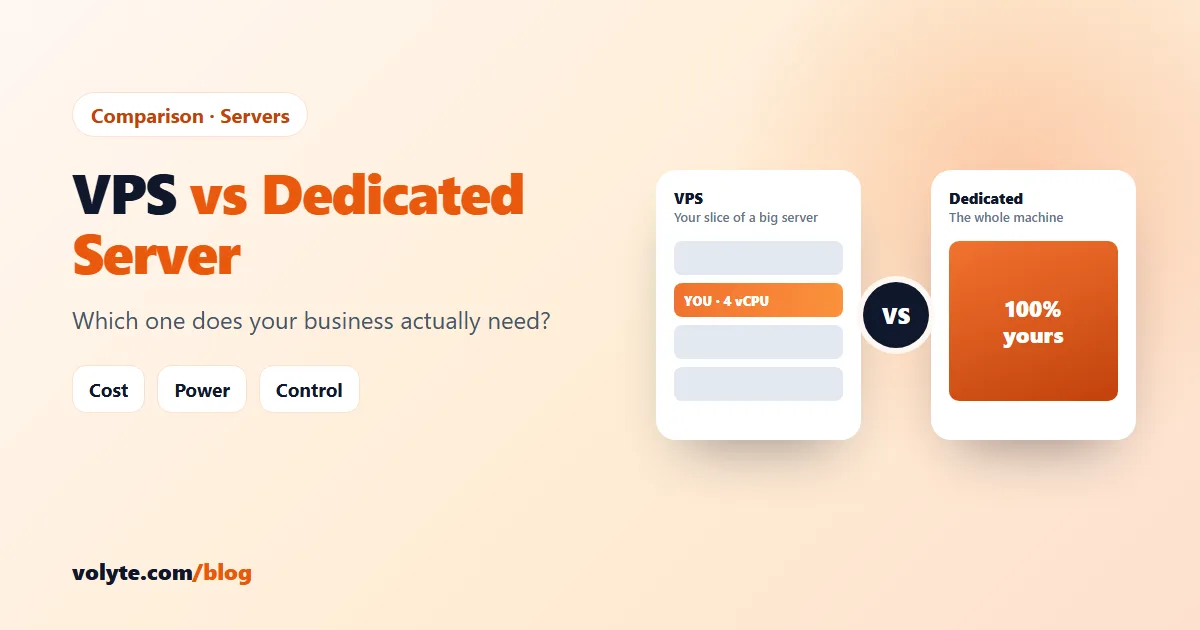
A VPS (Virtual Private Server) takes a physical server and partitions it into isolated virtual environments. You still share the underlying hardware with other VPS instances, but your CPU, RAM, and storage are reserved exclusively for you — a noisy neighbour can't eat into your slice the way they could on shared hosting.
Think of it like owning a flat in a building — same building, but your space is entirely yours.
- Starting price: From ₹999/month with Volyte (4 vCPU, 8 GB RAM, 100 GB NVMe)
- Best for: Growing e-commerce stores, SaaS apps, high-traffic sites, developers
- Management: Fully managed — our team handles setup, patching, and monitoring
What Is a Dedicated Server?
A dedicated server is exactly what it sounds like — an entire physical machine, with 100% of its resources going to you and nothing else. No virtualization layer, no other tenants, no shared anything.
Think of it like owning the whole building, not just a flat in it.
- Starting price: From ₹13,999/month with Volyte (AMD Ryzen 9, 64 GB DDR5)
- Best for: High-volume databases, large-scale e-commerce during peak seasons, compliance-heavy workloads
- Management: Fully managed, or self-managed with root access
VPS vs Dedicated Server: A Head-to-Head Comparison
| Feature | VPS Hosting | Dedicated Server |
|---|---|---|
| Price | From ₹999/mo | From ₹13,999/mo |
| Hardware | Shared physical server, isolated resources | Entire physical server, nothing shared |
| Performance | Guaranteed, consistent | Maximum, zero contention |
| Root access | Yes | Yes, full hardware control |
| Scalability | Upgrade resources anytime | Fixed to physical hardware |
| Renewal pricing | Same renewal price with Volyte | Same renewal price with Volyte |
When VPS Is the Right Choice
Most businesses reading this fall here. Consider a VPS if:
- Your site has outgrown shared hosting but doesn't need an entire physical machine
- You want guaranteed resources without paying for a full server you won't fully use
- You're running a growing WooCommerce store, SaaS product, or multiple sites needing predictable performance
- You want room to scale — most VPS plans let you upgrade RAM/CPU without migrating
When You Should Consider a Dedicated Server
This is a smaller, more specific group. Consider a dedicated server if:
- You've already scaled a VPS up as far as it goes and are still hitting a ceiling
- You're running resource-intensive workloads — large databases, high-traffic e-commerce during peak seasons, or video processing
- You have compliance or security requirements that genuinely need full hardware isolation, not just resource guarantees
- Predictable, maximum performance matters more to you than the cost difference
What About the Cost Difference?
The jump from a ₹999 VPS to a ₹13,999 dedicated server is significant, so it's worth being precise about when it's justified. If a VPS upgrade (more RAM, more vCPU) solves your actual bottleneck, that's almost always the cheaper and correct move. A dedicated server makes sense when the bottleneck isn't "more resources" but "zero sharing at any level" — and if that's genuinely your situation, you likely already know it from hitting a VPS's upper limits.
Can You Move From VPS to Dedicated Later?
Yes. With Volyte, our team handles the migration for free — your website, databases, and configurations, so you don't have to start on the biggest, most expensive plan "just in case." Start with what fits today, and move up when the numbers actually tell you to.
Our Recommendation
If you're asking "I need guaranteed resources instead of shared ones," that's a VPS question, and a VPS is very likely your answer. If you're asking "I need the absolute maximum a single machine can offer, with zero sharing at any level," that's a much smaller, more specific group — and dedicated is worth the jump.
Not sure which fits your stage? Explore Volyte VPS plans or see our dedicated server plans — both come with the same renewal price every cycle, so there's no surprise cost down the line either way.
Frequently Asked Questions (FAQ)
1. Is VPS hosting enough for a growing e-commerce store?
For most growing stores, yes. A VPS gives you guaranteed CPU, RAM, and storage that aren't affected by other tenants, which handles typical traffic growth and seasonal spikes well. Only very high-volume stores with heavy, sustained peak traffic usually need to move up to a dedicated server.
2. How do I know if I've actually outgrown a VPS?
The clearest sign is hitting resource limits consistently even after upgrading your VPS plan — if you're maxing out CPU or RAM at your VPS's highest tier during normal (not just peak) traffic, that's the point a dedicated server starts making sense.
3. Do I need technical knowledge to manage a dedicated server?
Not with a managed plan. Volyte's managed dedicated servers include setup, security patching, and monitoring, so you get full hardware isolation without needing an in-house sysadmin.
4. Is a dedicated server better for SEO than a VPS?
Not meaningfully, for most businesses. Google's ranking signals care about consistent speed and uptime, both of which a properly-sized VPS already delivers. A dedicated server only helps SEO indirectly if your current hosting is genuinely struggling to keep up with real traffic.
5. Can I switch between VPS and dedicated hosting without losing data?
Yes. Volyte's migration team handles the full transition for free — including website files, databases, and email accounts — with zero data loss and minimal downtime, in either direction.