
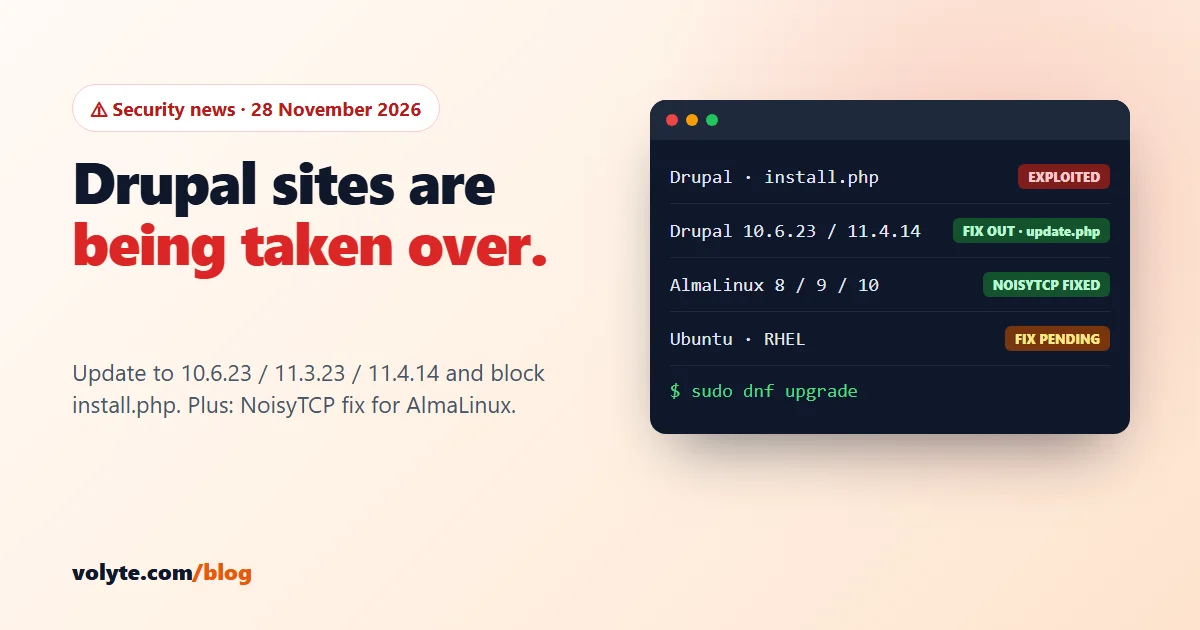
Updated 28 November 2026. Two things this week. Attackers are taking over Drupal sites through the Drupal installer, and a second fix came out on 25 November because the first one didn't close every gap. And there's good news on NoisyTCP, the Linux kernel crash bug from our 21 November news: AlmaLinux now has fixed kernels in its normal updates.
Short version: if you run Drupal 10 or 11, update to 10.6.23, 11.3.23 or 11.4.14 today, runupdate.php, block the installer, and check the user 1 account. On AlmaLinux 8, 9 or 10, runsudo dnf upgradeand reboot. Ubuntu and RHEL still have no fixed kernel.
At a glance
| Issue | Who is affected | Fix |
|---|---|---|
| Drupal SA-CORE-2026-017 (CVE-2026-132165) | Drupal below 10.6.22, 11.0 to below 11.3.22, 11.4.0 to below 11.4.13 | Superseded: go straight to the 25 Nov versions below |
| Drupal SA-CORE-2026-019 (CVE-2026-136716) | Drupal below 10.6.23, 11.0 to below 11.3.23, 11.4.0 to below 11.4.14. Attacked now | 10.6.23, 11.3.23 or 11.4.14, then run update.php |
| Linux kernel CVE-2026-99288 ("NoisyTCP") | Almost every Linux server with an open TCP port | AlmaLinux 8/9/10, Debian 12/13: fixed, update and reboot. Ubuntu, RHEL: no fix yet |
1. Drupal: attackers are reinstalling sites through install.php
Every Drupal site ships with an installer, install.php. On 18 November Drupal published SA-CORE-2026-017 (CVE-2026-132165), rated Highly critical (20/25): under certain conditions, an attacker could use the installer to reinstall Drupal on a live site. That means a full site takeover, and possibly running their own code on the server. Drupal later added that it was exploited on live sites from 19 November, 19:00 UTC, and CISA added it to its list of actively exploited bugs on 24 November.
Then on 25 November came SA-CORE-2026-019 (CVE-2026-136716), rated Highly critical (21/25). Drupal found that sites "in unusual or incomplete install states" could still be taken over after the first fix, including production sites. You can't tell from the admin screens whether your site is in that state. This one is also being exploited, and CISA added it on 27 November.
If you already secured your installer after setting up the site, Drupal says you are not affected. Most sites never did that, so treat every Drupal 10 or 11 site as at risk until it's updated.
Check your Drupal version
# From the site's folder, with Drush
drush status --field=drupal-version

# Or with Composer
composer show drupal/core | grep versions
You need 10.6.23 (Drupal 10), 11.3.23 (Drupal 11.3) or 11.4.14 (Drupal 11.4), or newer. Drupal 11.2 and older, and 10.5 and older, get no fix at all: they are end of life, so plan the upgrade to a supported branch now.
Update, and don't skip update.php
Take a backup or a VPS snapshot first. Then, for a Composer-based site:
composer update "drupal/core-*" --with-all-dependencies
drush updatedb -y
drush cache:rebuild
drush updatedb does the same job as visiting update.php. This step matters this time: Drupal says an update hook has to run to fix existing sites that are in the vulnerable state. Updating the files alone isn't enough.
Block the installer
Drupal strongly recommends securing the installer on every site, new and old. Once your site is installed, you don't need /core/install.php at all. Drupal's guide, Securing the installer, recommends blocking it in the web server configuration. On a VPS that looks like this.
Nginx: inside the server block that serves your site over HTTPS (find it with sudo nginx -T):
location ^~ /core/install.php {
  return 404;
}
Use ^~ exactly as shown. Drupal warns that an exact match (location = …) can still let URLs like /core/install.php/foo through on some setups. Then run sudo nginx -t && sudo systemctl reload nginx.
Apache: in your virtual host configuration (not in .htaccess, which gives a 500 error), including the HTTPS virtual host:
<Location "/core/install.php">
  Require all denied
</Location>
Then run sudo apachectl configtest and reload Apache. Don't block update.php by accident with a broad rule: you still need it for updates. Also make sure the web server can't write to settings.php: Drupal notes this blocks some of the attack paths.
Check whether someone got in
- Look for installer requests in your web server logs since 18 November:
sudo zgrep "install.php" /var/log/nginx/access.log*(or/var/log/apache2/). Requests from addresses you don't know are a warning sign. - Check the user 1 account (the first admin):
drush user:information --uid=1. The email must be one you control. Look for admin users you didn't create. - Reset user 1's password if anything looks wrong, as Drupal advises. Drupal also has a step-by-step guide for checking whether your site was compromised through the installer.
- If you find signs of a break-in, follow Drupal's guide "Your Drupal site got hacked. Now what?". Restoring a backup from before 18 November is often the safest route.
2. NoisyTCP: AlmaLinux kernels are fixed, Ubuntu and RHEL still waiting
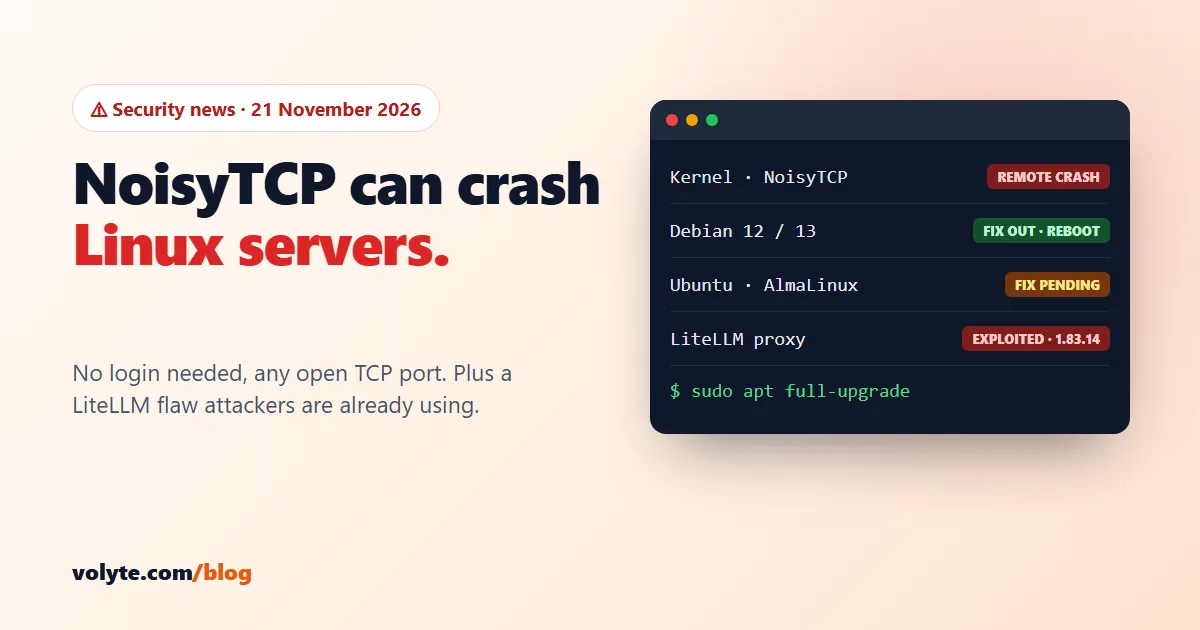
CVE-2026-99288 ("NoisyTCP") lets anyone who can reach an open TCP port crash an unpatched Linux server, with no login. It's a crash, not a takeover, but a crash means downtime. Full details are in our 21 November post. Here's what changed since then.
AlmaLinux 8, 9 and 10: update and reboot now
Since 23 November, the fixed kernels are in AlmaLinux's normal (production) repositories, so you no longer need the testing repo:
sudo dnf clean metadata && sudo dnf upgrade
sudo reboot
After the reboot, check your kernel with uname -r. You need this version or higher:
- AlmaLinux 8:
4.18.0-553.187.1.el8_10 - AlmaLinux 9:
5.14.0-741.24.1.el9_9 - AlmaLinux 10:
6.12.0-264.17.1.el10_3
If the update doesn't show yet, your mirror may not have synced: try again in a few hours.
Ubuntu and RHEL: still no fix
Ubuntu's page (updated 23 November) still lists every release as "Vulnerable, work in progress", with no security notice yet. Red Hat has no fixed RHEL kernel either. Debian 12 and 13 have had fixed kernels since before our last post. Until your fix lands, check for kernel updates daily, make sure your services start on boot (sudo systemctl is-enabled nginx should say enabled), and take a snapshot before you update.
Your weekend checklist
| Check | Done when |
|---|---|
| Drupal version | 10.6.23, 11.3.23 or 11.4.14 or newer, and drush updatedb has run |
| Drupal installer | /core/install.php returns 404 or 403, settings.php not writable by the web server |
| Drupal accounts | Logs checked, user 1 email is yours, no unknown admins |
| NoisyTCP on AlmaLinux | uname -r shows the fixed version or higher after a reboot |
| NoisyTCP on Ubuntu / RHEL | Services start on boot, snapshot taken, a daily check for the kernel update planned |
Running Drupal or AlmaLinux on a server and not sure where to start? Talk to our team on chat, ticket or phone: 24/7 in Hindi and English, real people. Setting up a new server? Start with our guide to securing a Linux VPS.
Sources: Drupal SA-CORE-2026-017, Drupal SA-CORE-2026-019, CISA KEV catalog, AlmaLinux NoisyTCP post, Ubuntu CVE-2026-99288, Red Hat CVE-2026-99288.
Frequently asked questions
Which Drupal version fixes SA-CORE-2026-019?
Drupal 10.6.23, 11.3.23 and 11.4.14. After updating, run update.php or drush updatedb, because an update hook has to run to fix existing sites. Drupal 11.2 and older, and 10.5 and older, are end of life and get no fix.
I updated after SA-CORE-2026-017. Am I safe?
Not necessarily. Drupal's 25 November advisory says some sites in unusual or incomplete install states could still be taken over after the first fix, including production sites. Update again to the 25 November versions, run update.php, and secure the installer.
How do I know if my Drupal site was hacked?
Check your web server logs for requests to install.php since 18 November, make sure the user 1 account still uses your email, and look for admin users you didn't create. If anything looks wrong, reset user 1's password and follow Drupal's guide for hacked sites.
Is there a NoisyTCP fix for AlmaLinux?
Yes. Since 23 November the fixed kernels are in AlmaLinux 8, 9 and 10's normal repositories. Run sudo dnf clean metadata and sudo dnf upgrade, reboot, and check the version with uname -r.
I'm on shared web hosting. Do I need to do anything?
For NoisyTCP, no: your host handles the server kernel. For Drupal, yes if you installed Drupal yourself on your hosting account: update Drupal core, as only you can update your own site.